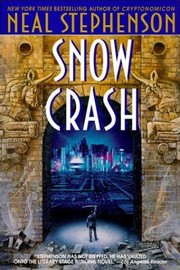
Snow Crash
3,293-word summary 15 min read 440 pages in the book
- First published
- 1992
- Publisher
- Bantam Books
- Pages
- 440
- ISBN
- 9780553380958
Reading options
What's inside (8 sections)
I picked up Snow Crash because every programmer I knew quoted it and none of them agreed what it was about. One said virtual reality. One said Sumerian grammar. One said pizza. All three were right, which is the fun and the problem of this book. It was published in 1992 by Bantam Books. It runs 440 pages in first edition. It follows a hacker who delivers pizza for the Mafia and a fifteen year old courier who talks about herself in the third person, and it throws them at a drug that is also a computer virus that is also a religion. I read it fast, then sat still for a while.
Hiro Protagonist is the kind of name that tells you the joke before the plot does. In the real world he is a freelance hacker scraping by as a Deliverator for CosaNostra Pizza, where the promise is thirty minutes or less and the penalty for lateness is ugly. He carries katana swords and takes the job seriously in a way the job does not deserve. In the Metaverse he is someone. He helped build the Black Sun, the club where the best hackers hang out, and his avatar walks in like it owns the carpet. That split, nobody in one world and somebody in the other, powers the whole first act.
The opening delivery is the book showing off. Hiro takes a run that goes wrong in traffic, and a Kourier on a smart wheeled plank crosses his path at speed. She is Y.T., short for Yours Truly, fifteen, working the courier trade with a harpoon gun and total confidence. She finishes his delivery for him, or close enough that it counts, and the two of them fall into a working friendship. She skates and surfs traffic. He pays for information and tips. They sell what they learn to the CIC, which is what the CIA became after it merged with the Library of Congress, a private intel company that pays stringers for entries in its Library. That setup gives the book its engine. Two freelancers keep tripping over the same secret from opposite sides.
The secret is called Snow Crash. On the street it is a drug. In the Metaverse it is a file, a bitmap image that crashes computers and injures the people watching. Hiro watches it happen to his friend Da5id, a fellow hacker who looks at the image inside the Black Sun and collapses in real life with his brain misfiring. That scene lands because Stephenson treats it as plain fact. Code can hurt hackers directly because hackers process symbols the way computers do, or close enough that the difference stops mattering. From there Hiro starts digging, and Y.T. starts noticing the same names from street level, and the two threads pull tight.
Thirty minutes or less, with swords
The pizza job is satire with a stopwatch. The Mafia runs the pizza chain, and Uncle Enzo, the boss, treats punctuality as honor and courtesy as policy. Hiro fails at the job in the specific way the system punishes most, late with a good excuse, and Y.T. saves the run by doing something reckless on her plank. Smartwheels read the road. The harpoon catches bumpers. Traffic becomes a thing to ride instead of a thing to wait in. I love these early chapters because the rules are clear and the physical comedy is exact. Every turn has a cost measured in seconds.
Y.T. carries these pages. She is quick, rude, brave, and professional about a job most adults would call a death wish. She calls herself Yours Truly and means it as branding. She hitches rides with her harpoon, argues with drivers through their windows, and files her runs with the pride of a pilot. Stephenson writes her as fully competent, which matters later when the book puts her in rooms with powerful men. She never reads as a mascot. She reads as the person most likely to survive the scene.
Hiro reads stranger. He is the best swordsman around, a serious hacker, a decent analyst, and a terrible employee, and the book knows this is a lot. The name Protagonist is doing signal work. This is a hero built from spare parts of older heroes, samurai and console cowboys both, and the pleasure is watching Stephenson push the type until it wobbles. Sometimes Hiro feels like a person. Sometimes he feels like a demo of cool skills. Your patience for that wobble decides a lot about your patience for the book.
Uncle Enzo enters here and steals every scene he touches. He is old school courtesy inside a crime franchise, and he takes a fatherly interest in Y.T. after she impresses him. He gives her work. He warns her about dangers she already knows. He treats her like a young professional instead of a kid, which she is, and like a daughter instead of an asset, which she is not. Their bond is one of the few warm things in a cold book, and it pays off in the final act when Enzo puts his body where his manners are.
A country of franchises and a Street that never ends
The future Stephenson builds is America after the center gave way. The federal government still exists in pockets, doing make work in compounds while the real power sits with franchises. The phrase in the book is FOQNEs, Franchise Organized Quasi National Entities, which is a mouthful that the story earns. Mr. Lee runs Greater Hong Kong as a nation business. Suburbs are burbclaves with their own laws and guards. Highways compete for drivers. Mail goes by courier. Money has inflated past sense, so people count in millions and billions and trade in yen and Kongbucks without blinking. It is played for laughs until you notice the refugees, and then it stops being funny in the intended way.
Above this sits the Metaverse, the word Stephenson coined here, a virtual world entered through goggles and terminals. Picture one long Street circling a dark planet, lined with buildings and ports, with a monorail running its length. People walk it as avatars of whatever shape they can afford to render. Rich avatars look real. Poor ones look blocky, and everyone can tell. Public terminals give a grainy picture, and regulars look down on people who log in that way. Some users never log out and wear their gear everywhere, earning the nickname gargoyles for how they look shuffling through airports. Status comes from where you can go and how good you look getting there. The Black Sun is the door that matters, and Hiro can walk through it.
I found this the part of the book that aged best and worst at once. Best because so much of it arrived. Avatars, virtual clubs, online status games, a globe program that maps the Earth in detail, stringers paid for database entries. The CIC Library reads like a paid wiki with bounties, and the Earth software reads like a prophecy of virtual globes. Worst because the book assumes the future keeps the phone company in charge. One man, L. Bob Rife, owns the fiber that carries the Metaverse, which gives him the kind of control the real internet routed around. Stephenson saw platforms coming. He put the platform in one pair of hands for story reasons, and history split the difference.
Rife is the villain, and he is built like the world. A media and cable magnate turned would be emperor, collecting Sumerian artifacts and funding churches and running a fleet from a yacht that used to be an aircraft carrier. He wants what every monopolist in this book wants. Not money, which he has, but the layer under money. Attention, belief, the words people think with. Snow Crash is his tool. The plan sounds wild until Lagos lays out the theory, and then it sounds wild in a second way that is harder to dismiss.
Y.T., Uncle Enzo, and a glass eyed killer
The middle of the book belongs to Y.T. in motion. She takes courier jobs that pull her across franchise borders. She spies a little, sells a little intel, and keeps her mother fed. Her mother works for the remnant federal government in a job the book treats with real sympathy, endless forms in a compound while the country outside runs on franchise scrip. That contrast gives Y.T. weight. She is not skating for fun. She is the working part of a household, and every run is rent.
Her jobs keep crossing Raven. He is an Aleut harpooner turned legendary killer, huge, silent, funny in the way storms are funny, with a glass eye and a motorcycle whose sidecar carries a nuclear device tied to his own body. Killing him sets it off, which limits the options of everyone who meets him. He works for Rife when it suits him and follows his own code the rest of the time. The book uses him sparingly, which is correct. A little Raven goes a long way, and every appearance resets the stakes. When he looks at Y.T., the age gap and the threat register exactly as they should. She is brave. He is doom on wheels. The story never confuses those.
Uncle Enzo keeps showing up at the right moments with jobs, advice, and protection that Y.T. accepts on her own terms. He admires her because she reminds him of himself young, and he says so without making it creepy. Given how the book sometimes looks at Y.T., those scenes matter. Enzo models the correct response to her, which is respect for the professional. He also gives the Mafia chapters their charge. CosaNostra Pizza is a joke about brands becoming nations. Enzo is the proof that honor can live inside the joke. When he fights, it is not for show. It is policy expressed with hands.
There is also Fido, a Rat Thing, which needs a sentence. Rat Things are cybernetic guard dogs, fast as cars, loyal as saints, built from pit bull parts and company tech. One of them takes a liking to Y.T., and the book gets real mileage from a friendship between a girl and a missile shaped dog. It sounds silly. On the page it works, because the Rat Thing has clearer loyalties than most humans here. When the end comes apart at the airport, you will be glad Fido is around. I was.
Sumer, Babel, and a drug that is also a picture
Here is the theory part, and readers divide here. Lagos is the researcher who connects the dots before dying for the trouble. He works the Library angle, gathering deep background on language, myth, and old clay. His claim, passed to Hiro through Juanita, runs like this. The ancient Sumerians spoke a language that the brain processed differently, a root tongue that could program people the way code programs machines. Priests administered batches of instructions called me. Society ran on spoken updates. Then a figure called Enki released a counter program, the nam shub of Enki, that broke the root tongue into many descendants. The Bible remembers the event as Babel. The confusion of tongues was a firewall going up.
Snow Crash is the attempt to tear the firewall down. Rife has dug up the old materials and built a virus with two forms. One is chemical, a drug that makes brains open to instruction. The other is digital, an image that hits hackers through their optic nerves and their habits of thought. Both carry the same payload. Obedience shaped by whoever controls the new me. Rife has the distribution figured out through his church franchise, Reverend Wayne and his Pearly Gates, where blood rites move the physical virus, and through the Metaverse, where the digital form hunts the exact people smart enough to stop it. It is a lot. Lagos makes it sound almost sane, which is the point of Lagos. He is the kind of scholar who can make clay tablets feel like breaking news.
Juanita is the one who brings Hiro this file and tells him to be careful. She is his ex, which the book treats as history with unfinished edges rather than a puzzle to solve. She works on faces and avatars, on how people read each other through masks, and she understands the virus in a way Hiro does not at first. Where Hiro sees code, she sees persuasion. Where he wants to hack the file, she wants to understand the story around it. She has already gone inside Rife world by the time Hiro catches up, and her path through the Raft chapters gives the book its second center. Hiro runs the errands. Juanita does the reading that matters.
I will be honest. These chapters slowed me down. The Sumer material arrives in long briefings, dialogue shaped like lectures, with Hiro asking the questions a reader would ask and Lagos or Juanita answering at length. Some of it sings. The idea that stories can act like programs, that a myth can be a patch, is catnip if you like language. Some of it drags. Pages about phonemes and tablets pile up while Y.T. is out risking her neck, and the book keeps cutting back to class. A friend told me to treat Lagos like a professor you like. Take notes, forgive the tangents, wait for the exam. The exam is the Raft, and it is worth reaching.
The Raft and the reading that breaks it
The Raft is the book cashing every check it wrote. Off the Oregon coast gathers a floating mass of boats, refugees from Asia crossing the Pacific in anything that floats, lashed together into a moving city. At its heart sits Rife yacht, the old Enterprise carrier turned palace, where the virus operation runs. The Raft is miserable and vivid, hungry people used as cover and as carriers, faith and sickness moving boat to boat. Y.T. gets pulled into it as a captive, which flips her from observer to hostage and raises the price of everything Hiro does next.
Hiro heads north with Mafia help and company toys. There is a portable railgun called Reason with strong opinions about walls. There are smart reasons to be afraid of Raven, who guards Rife interests and wants his own fight with Hiro for personal reasons. There are runs through corridors and across decks that read like the book remembering it started as an action story. Stephenson stages all of it well. Sight lines, reloads, bad footing on wet steel. Hiro the swordsman finally gets rooms shaped for swords, and the contrast with guns and dogs and wire keeps the fights from blurring.
The turn is not a bigger gun. It is a reading. Juanita has carried the nam shub of Enki into the heart of the operation, and with Hiro help the counter program goes out. The words break Rife hold on the Raft the way the old story says they broke Sumer, scattering one obedience into many voices. I will not spoil the exact mechanics beyond that, since the pleasure is in watching a linguistics lecture become a weapon. The book earns one sincere cheer here. All those tablet chapters turn out to be the plan, not the delay.
Rife runs with Y.T. as a hostage, and the end splits three ways. Raven tries to loose the digital Snow Crash at a virtual concert in the Metaverse, which would seed it to thousands of watchers at once. Hiro meets him there in the form the book has been building toward, hacker against image, with everything about avatars and attention suddenly mattering. Y.T. gets free in the real world through courage and a dog. At the airport, Raven and Uncle Enzo have their fight, manners against menace, and it ends the only way it could, both men broken and neither yielding. Rife dies trying to leave. Y.T. gets home to her mother. Hiro and Juanita find their way back to each other, tired and careful. It is a lot of ending. It mostly lands because every thread was loaded early.
What still lands and what creaks
What lands first is the nerve. This book named the Metaverse and helped fix the word avatar in computing culture, and it did both inside a story that moves. The franchise future reads as satire aimed true. Private armies, company nations, highways as products, intel as piecework. The CIC stringer economy describes twenty years of web labor before the web could pay for it. The virtual globe on CIC screens points straight at the mapping tools we carry now. Stephenson gets details wrong in the fun way prophets do. Gargoyles with goggles instead of phones in pockets. Fiber owned by one man instead of split among giants. The shape is right even where the labels are off.
What lands second is Y.T. She is the book beating heart, and the plot knows it. Her chapters have the best sentences and the clearest wants. Hiro can feel like a thesis in a leather jacket. Y.T. feels like a person late for work. When the virus plot turns abstract, her scenes pull it back to bodies and rent and mothers. If you have ever been young and good at a job adults failed to respect, these pages will sting in a good way. Enzo respect for her reads as the book at its most decent. Fido love for her reads as the book at its most sincere.
What creaks is real too. The middle lectures stall the story, and no love of Sumer fully fixes the pacing. Hiro competence stack tips into parody without always admitting it, and the name joke does not cover every escape. Some passages about Y.T. leer in a way that has aged badly, even with the book insisting on her skill. She is fifteen, and the camera sometimes forgets what it owes her. Readers should know that going in. The book also swings tone hard, from slapstick to seminar to slaughter, and the final act asks you to track a sea battle, a virtual concert, and an airport duel at once. I kept up. I also checked the page count twice.
So who should read it. If you like cyberpunk with jokes, systems fiction that explains its magic, or stories about language that take myth seriously, this is a feast. Programmers get extra layer of gags about operating systems and networks, including the title itself, which comes from an old Mac failure mode where a crash filled the screen with static like snow. If you want tight plotting, steady tone, or characters who grow the way literary heroes grow, this may wear you down. It is a 1992 Bantam book with 1992 edges, fast, smart, careless, and twice as confident as it has any right to be.
I closed it thinking about the Street. One road around a dark world, full of doors, with everyone performing rank through how they look. That image stuck harder than any plot point, and I suspect it stuck for a lot of other people too. The honors make sense from there. Nominations for the British Science Fiction Award and the Arthur C. Clarke Award, a spot on the Time list of best novels, and a long tail through games and virtual worlds and one very famous company rename. Influence is not proof of quality. Still, when a throwaway road in a hacker novel becomes the map half of tech uses for thirty years, something on the page was working. For me it was Y.T. on her plank, Hiro with his swords, and a story that trusts a dead language to save the living.
FAQ
When was Snow Crash published?
It was published in June 1992 by Bantam Books in the United States, with a first edition of about 440 pages. The summary follows that text.
Is Snow Crash part of a series?
No. It is a standalone novel. Stephenson revisits some ideas in The Diamond Age, but the plot and characters do not continue.
Do I need to know computers to enjoy Snow Crash?
No. The hacking and Sumerian theory are explained in the story, and the Y.T. chapters read as straight adventure. Programmers catch extra jokes, but the plot carries without them.
Similar books
More like Snow Crash →
Oryx and Crake
Snowman lives alone after the plague with Crake's green-eyed Children, remembering Jimmy, Crake and Oryx.
3,026-word summary · 13 min read

Brave New World
Huxley's Brave New World retold: hatcheries, soma, Bernard and Lenina, John the Savage, and the lighthouse.
2,513-word summary · 11 min read

The Restaurant at the End of the Universe
Arthur Dent flees Vogons, dines at Milliways at the end of time, and strands on prehistoric Earth in Adams' sharp 1980 sequel.
2,749-word summary · 12 min read

The City of Ember
Two twelve-year-olds trade jobs and chase a chewed-up note to save their fading underground city before its lights fail.
2,998-word summary · 13 min read

Golden Son
Darrow serves House Augustus as a Gold officer while plotting revolt, until a gala refusal, a duel with Cassius, and a Triumph betrayal break his rise.
2,747-word summary · 12 min read

Destroy Me
Shot by Juliette, Warner holds his base together while his father arrives with harsher plans for her.
2,556-word summary · 11 min read