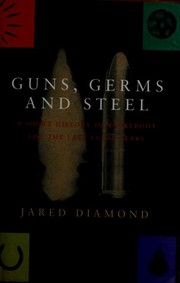
Guns, Germs, and Steel: The Fates of Human Societies
3,432-word summary 15 min read 480 pages in the book
- First published
- 1997
- Publisher
- W. W. Norton
- Pages
- 480
- ISBN
- 9780393049275
Reading options
What's inside (8 sections)
I picked up Guns, Germs, and Steel because a friend kept bringing it up whenever history came up at dinner. He would say it changed how he saw maps. I was skeptical. A book from 1997, published by W. W. Norton, running 480 pages, that claims to explain the last 13,000 years of everybody? That sounded too big to be useful. I read it slowly over two weeks, mostly in the mornings, and I ended up arguing with it in the margins almost every day. That is probably the point.
Diamond is a biologist who spent years doing fieldwork in New Guinea. He writes like a scientist who wandered into history and stayed. The book won the Pulitzer for general nonfiction in 1998, and you can feel why. It tries to answer a very direct question without falling back on the idea that some people are smarter or harder working than others. Whether he fully pulls it off is another matter, and I will get to that, but the drive of the question kept me turning pages.
The short version of his answer is in the subtitle of the British edition: a short history of everybody for the last 13,000 years. He thinks food, animals, germs, and geography set up very different starting lines. Those early gaps widened over time. Guns and steel show up late in the story, as results, not first causes.
Yali's question in New Guinea
The book opens with a man named Yali. He was a politician in Papua New Guinea who Diamond knew from fieldwork. They were walking on a beach in 1972, talking about the obvious difference in material goods between New Guineans and Europeans. Yali asked why white people had so much cargo and New Guineans had so little. By cargo he meant manufactured things. Axes, clothes, umbrellas, trucks, radios. The stuff that arrives in crates.
Diamond says the question stayed with him for twenty five years. It was not really about cargo. It was about power. Why did Europeans arrive as colonists in New Guinea, and not the other way around? Why did one group have writing, metal tools, centralized politics, and ocean ships, while the group living in a rich, fertile place did not develop those things in the same form?
I liked this start because it is personal and a little uncomfortable. Diamond admits he did not have a good answer at the time. He also says straight away what he will not argue. He will not argue that Europeans succeeded because they were more intelligent or more moral. He thinks that explanation is wrong and lazy. He wants a chain of causes that does not need it.
That promise shapes the whole book. If you remove brains and character as explanations, what is left? His answer is environment, plus the feedback loops that environment allows. A small early lead in food production becomes a larger lead in population, then in specialists, then in technology and disease resistance, then in the ability to expand or resist expansion.
It is easy to nod along here. It is harder when he starts naming winners and losers by continent. Keep Yali in mind while you read. Diamond keeps coming back to him. The question is not abstract. It is about real people looking at unequal outcomes and asking for an honest reason.
Why farming started in so few places
For most of human history, everyone lived by hunting and gathering. Then, starting around 11,000 years ago in a few places, people began to farm. They planted crops. They kept animals. They stayed put. That shift, often called the Neolithic transition, is the hinge of the whole book.
Diamond spends a lot of time on where farming started and why it started there. The most important early center was the Fertile Crescent, the arc running through present day Israel, Jordan, Lebanon, Syria, Turkey, Iraq, and western Iran. The climate there after the last ice age was dry enough to store food, wet enough in winter to grow cereals, and rich in wild plants that could be turned into crops.
The founder crops matter here. Wild emmer and einkorn wheat, barley, peas, lentils, chickpeas, bitter vetch, and flax. Those wild ancestors were already productive and nutritious. They were also relatively easy to select for better traits. A mutation that kept seeds on the stalk instead of shattering, so humans could harvest them, could spread fast once people started replanting. Diamond walks through this plant by plant, which I found slow in spots but convincing. You start to see farming not as an idea someone had, but as something that was possible in some places and close to impossible in others.
Other centers followed, independently, at different times. China gave rice and millet. Mesoamerica gave corn from teosinte, plus beans and squash. The Andes gave potatoes and quinoa. The eastern United States gave sunflower and goosefoot. The Sahel and Ethiopia and New Guinea gave their own crops. Diamond lists dates and debates them. He is careful to say farming was invented more than once.
But not all farming packages were equal. Wheat and rice are calorie dense, easy to store, and high in protein compared with, say, bananas or yams. Cereals can be kept in bins for a year and eaten in winter. Roots and bananas are harder to store at scale. That difference affects whether a village can support full time potters, masons, priests, clerks, soldiers. Surplus that stores is surplus that can feed people who do not farm.
My favorite detail in this part is about timing. People in the Fertile Crescent got a head start of thousands of years. That head start compounded. Earlier farming meant earlier population growth, earlier towns, earlier writing, earlier metal. When Diamond says history has a fast lane and slow lanes, he mostly means this farming clock.
He also admits luck played a part. The Fertile Crescent had the right wild species in one compact area. No one designed that. If you reshuffled the wild plants of the world, history might look different. That kind of counterfactual pops up a lot, and I found it helpful even when I was not sure I believed every step.
The plants and animals that mattered most
If crops are half the story, animals are the other half. Diamond is blunt about the numbers. Out of 148 large wild mammals that look like candidates for domestication, he says only 14 were ever successfully domesticated. Five became central: cows, horses, sheep, goats, and pigs. All five came from Eurasia.
Why so few? He borrows a phrase from Tolstoy and calls it the Anna Karenina principle. Successful domesticates all had to clear several tests at once. They had to eat a diet humans could supply. They had to grow fast enough to be worth feeding. They had to breed in captivity. They had to tolerate people without panicking. They had to live in groups with a hierarchy humans could take over. Fail any one test and the species stayed wild.
This is where the book gets fun and specific. Zebras look like horses but bite, kick, and do not settle in pens. African buffalo are dangerous and unpredictable. Onagers, the wild asses of Asia, resist handling. Elephants can be tamed but breed poorly in captivity, so each working elephant had to be caught wild. Acorn fed pigs in Eurasia worked. Peccaries in the Americas did not take in the same way. Diamond goes case by case, and even if you doubt a few calls, the pattern is striking. Eurasia simply had more large animals that would put up with us.
Domestic animals gave more than meat. Cows gave milk. Sheep gave wool. Goats gave hides and cheese. Oxen pulled plows and turned heavier soils into fields. Horses and camels and donkeys carried people and goods over long distances. That last point matters more than it sounds. Before trucks, a society with pack animals and later with mounted riders could move grain, timber, orders, and soldiers far faster and cheaper than a society that carried everything on human backs.
Manure counts too. A field fertilized by penned animals can be farmed longer without losing yield. That allows denser settlement. Denser settlement allows more interaction, more exchange, more specialization. Diamond connects these links patiently, sometimes too patiently. I skimmed a little in the middle of this stretch.
Then he adds the axis idea, which is probably the most famous map in the book. Eurasia runs mostly east to west. The Americas and Africa run mostly north to south. That matters because climate bands run east to west. A crop domesticated in Syria can spread to Spain or to northern China without leaving a similar band of day length and seasons. A crop domesticated in Mexico has a hard time moving to the Andes because everything in between is different. Hot lowlands, high mountains, deserts, rainforest. Same for animals and for the farming techniques that go with them.
He gives the example of wheat moving along Eurasia in a few thousand years, while corn took much longer to move north and south in the Americas and had to adapt at each step. Horses, once reintroduced by Europeans, spread fast on the Great Plains because the grassland suited them, but that was after Europeans brought them. The original American horses had died out near the end of the ice age, possibly with human help. Australia lost its large mammals even earlier. New Guinea, cut off by water, got pigs and chickens late and never got cattle or horses until modern times.
Short chapters carry this point. A big continent with the same climates sideways shares inventions fast. A continent chopped up by climate from top to bottom shares slowly. I drew the axes on scrap paper and it clicked.
Germs, writing, and other slow multipliers
Food surplus does not just feed more mouths. It changes what people can do all day. Diamond calls the result a set of multipliers. When farmers produce extra, some people can stop farming. They become toolmakers, builders, priests, administrators, soldiers, scribes. Those roles then make farming more productive, which supports still more specialists. It is a loop.
Writing is his clearest example. It did not appear because someone loved poetry. It appeared because early states needed to track grain, labor, taxes, and debts. He traces Sumerian marks on clay that started as tokens for sheep and barley and slowly turned into script. Once writing exists, it can be borrowed and adapted. The alphabet that reaches us through Phoenician and Greek sources spreads because it is useful for administration and trade, then later for law, religion, and science. Societies without dense, storable surpluses had less use for that kind of record keeping, so writing arose in fewer places and spread more slowly where geography blocked contact.
Technology works the same way in his telling. Steel does not come from one clever blacksmith. It comes from long chains. You need miners, charcoal burners, furnace builders, traders to bring copper and tin or iron ore, and a political system that can feed all of them while they experiment. Eurasia had many such chains touching each other. A better bellows in one place, a better furnace lining in another, a new way to quench. Ideas leaked across the east west band. In isolated places, a good idea could appear and then vanish because there were too few people to keep it alive.
Germs are the darkest multiplier, and Diamond gives them a full treatment. Most of our worst crowd diseases came from animals. Measles from cattle relatives. Tuberculosis from cattle. Flu from pigs and ducks. Smallpox from a related animal pox. These diseases need large, dense, settled populations to keep circulating. Hunter gatherer bands were too small and too mobile to host them for long. Farming villages and then cities were perfect hosts.
Over centuries, Eurasians lived with these pathogens. Many children died. Survivors carried resistance. Adults who had caught a disease as children were often immune later. That immunity was tragic to gain and powerful once held. When Europeans crossed the Atlantic after 1492, they brought smallpox, measles, influenza, typhus, and others to peoples who had never met them. The result was catastrophic. In Mexico and Peru, Diamond reports, epidemics killed a huge share of native peoples, sometimes before Europeans even arrived in person, carried ahead along trade routes.
He is careful to say this was not deliberate biological warfare in most cases, though deliberate cruelty certainly happened. It was mostly accidental and still devastating. A small party of Spaniards could walk into a city already hollowed by disease, where leadership had died and food systems had broken down. Guns helped. Steel helped. Horses scared people who had never seen them. But germs, he argues, did the largest share of the killing.
I found these chapters the strongest and the hardest to read. Strongest because the mechanism is clear and tied to farming and density. Hardest because the human cost is laid out without flinching. Diamond cites accounts of villages where there were too few healthy people left to bury the dead. He also notes the partial exception that proves the pattern. In Africa, malaria and yellow fever killed Europeans in large numbers and limited inland conquest until quinine and later medicine changed the balance. Disease cut both ways where the disease pools were deep on both sides.
Cajamarca and what conquest looked like up close
Diamond does not stay abstract the whole time. He keeps returning to specific collisions. The most detailed is Cajamarca in 1532, when Francisco Pizarro met the Inca ruler Atahuallpa in the highlands of Peru.
The numbers sound impossible. Pizarro had 168 men, with 62 horses, a few small cannon, and steel swords and armor. Atahuallpa came with thousands of attendants and soldiers, fresh from winning a civil war, confident, and curious. Pizarro invited him to meet, hid his men around the town square, seized him in a sudden attack, and later ransomed and executed him. Within a few years the Inca state fell apart, even though Inca armies kept fighting.
Diamond uses Cajamarca to show his chain in miniature. Why did Spaniards have steel swords while Inca soldiers had clubs and quilted armor? Why did Spaniards ride horses while Incas had llamas, useful pack animals but too small to ride into battle? Why did Spaniards carry writing, so Pizarro could read accounts of Cortes in Mexico and plan accordingly, while Inca administration relied on knotted cords and runners, brilliant in its own way but slower for distant planning? Why did smallpox arrive ahead of Pizarro and kill the previous Inca ruler and his heir, sparking the very civil war that left Atahuallpa exposed?
He gives other cases in shorter form. Cortes in Mexico, where disease, steel, horses, and divisions among Aztec subject peoples combined. European settlement in Australia and southern Africa, where guns and imported food systems displaced hunter gatherers who had thrived for tens of thousands of years. Bantu expansion in Africa, where farmers with iron and cereals moved into lands held by herders and foragers. Polynesian expansion in the Pacific, where the Lapita peoples with root crops and chickens and pigs reached islands others could not settle as densely.
None of these stories are told as adventures. Diamond keeps pulling back to logistics. How many calories per acre? How many days to carry a message? How many people can one blacksmith equip? I appreciated that discipline. It stops the book from turning into great man history. Pizarro was ruthless and lucky, but in Diamond's telling he rode a wave built over thousands of years.
At the same time, this is where I started to push back in my notes. Logistics explain a lot, but people still make choices. Atahuallpa made mistakes. His generals made choices. Spanish politics, religion, and greed shaped what happened next. Diamond knows this, and he says culture and decisions matter up close. But the book spends far more pages on soil and sheep than on councils and beliefs. That tilt is deliberate. It still left me wanting more about how societies used the tools they had.
Where the argument feels thin
This book has been argued about since it appeared, and for good reason. The praise was loud. It brought biology and geography into history in a way many readers had never seen. Teachers assigned it. Scientists outside history praised its range. I can see why. When it is good, it connects things you thought were separate. Wheat and writing. Pigs and measles. Latitude and alphabets.
The criticism has been loud too, and some of it stuck with me after I finished.
The first complaint is determinism. Critics say Diamond leaves too little room for human agency, culture, and politics. If geography sets the path, why did China, which unified early and led in technology for centuries, fall behind western Europe in ocean expansion after the 1400s? Diamond answers that Europe's broken coastline and competing states forced constant rivalry, while China's unity allowed a single decision to halt treasure fleets and slow overseas trade. That is a clever turn. It uses geography to explain fragmentation. But historians reply that politics, law, religion, and institutions did real work too, and Diamond moves past them fast. Reading about early modern Europe, I felt that gap. The map helps. It does not vote, tax, or preach.
The second complaint is about Africa. Diamond treats sub Saharan Africa as disadvantaged by a north south axis, by deserts and rainforest belts that blocked crop movement, and by a smaller set of domesticable plants and animals. Critics answer that Africa had its own centers of farming, iron working, trade, and state building, from the Sahel kingdoms to Great Zimbabwe to Ethiopia, and that the book flattens them. They also point out that Eurasia borrowed heavily from Africa and Asia and that lumping Europe with China and the Fertile Crescent under one label hides huge differences. I thought this criticism landed. The Africa chapters felt thinner than the Fertile Crescent chapters, with fewer named people and places.
The third complaint is about precision. Specialists in linguistics, archaeology, and plant genetics have corrected details since 1997. Dates for domestication have shifted. Some plant identifications have been refined. The claim that exactly 14 large mammals were domesticated depends on definitions. Zebras have been tamed in circuses, though not truly domesticated in the breeding sense Diamond means, and critics say the line is blurrier than he allows. None of these corrections breaks the main arc for me, but they add up. A book that leans on specifics invites checking, and some specifics have not aged perfectly.
The fourth complaint is moral. Anthropologist Jason Antrosio and others have said the book makes conquest look accidental, which softens responsibility. Diamond does condemn cruelty when he describes it. He does not celebrate Pizarro. But by stressing that Spaniards were carriers of a long chain rather than heroes, he can sound like he is excusing them. I did not read him that way. He seems to think understanding causes is separate from assigning blame. Still, a reader who wants a fuller account of resistance, survival, and adaptation by Native peoples will need other books. This one looks mostly from the side of the expanders.
What would I tell a friend now? Read it for the framework, not as the last word. The Fertile Crescent section and the germs section are worth the price alone. The axis maps will change how you look at atlases. Take the bolder claims about why Europe and not China with more salt. Pair it with a history of the Mexica or the Inca told from inside, and with a history of Africa that names kingdoms and traders, so the people who get flattened here come back into focus.
I closed the book thinking less about guns and more about storage. A bin of grain that lasts winter seems boring until you see what it allows. Clerks. Schools. Furnaces. Ships. Hospitals. Armies. Once one region gets that loop spinning earlier, others have to cope with the results, often under terrible terms. That image has stayed with me longer than any single battle scene, and it makes Yali's question feel less distant. He was asking about crates on a beach. Diamond answers with 13,000 years of bins, barns, and boats. The answer is incomplete, and sometimes too neat, but it is serious, and it respects the question enough to try.
FAQ
What is Yali's question?
Diamond opens with Yali, a politician in Papua New Guinea, who asked why Europeans arrived with so much manufactured cargo. The book is his long answer to that question.
What is Diamond's main explanation?
He argues Eurasia had more domesticable plants and animals, an east-west axis for easy spread, and crowd diseases that later devastated nonimmune peoples. Guns and steel came late as results of those leads.
Do historians accept the argument fully?
Read it for the framework on farming, animals, and germs, but pair it with histories told from inside Native and African societies. Specialists have corrected details and stress politics and culture more.
Sapiens: A Brief History of Humankind
Harari's Sapiens from cover to cover: the cognitive revolution, the agricultural bargain, shared fictions like money and nations, and the scientific centuries…
2,145-word summary · 10 min read

The Prince
Machiavelli advises Lorenzo on rule through fear and love, fortune, cruelty and mercy.
2,204-word summary · 10 min read
The Boys in the Boat: Nine Americans and Their Epic Quest for Gold at the 1936 Berlin Olympics
Washington rowers led by Joe Rantz chase gold in Hitler's Berlin in 1936.
2,439-word summary · 11 min read

Killers of the Flower Moon: The Osage Murders and the Birth of the FBI
In 1920s Oklahoma, Osage oil wealth makes tribal members targets for murder, forcing the young FBI under Tom White to expose the conspiracy behind the Reign of…
2,403-word summary · 11 min read

John Adams
McCullough follows Adams from Braintree lawyer to second president.
2,515-word summary · 11 min read

Between the World and Me
Coates writes to his son about the Black body in America, from Howard to the loss of Prince Jones.
2,234-word summary · 10 min read