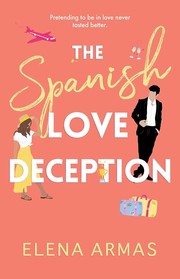
The Spanish Love Deception
2,006-word summary 9 min read 448 pages in the book
- First published
- 2021
- Publisher
- Atria Books
- Pages
- 448
- ISBN
- 9781668002520
- Series
- Spanish Love Deception (#1)
Reading options
What's inside (8 sections)
I picked up The Spanish Love Deception because BookTok would not stop talking about Aaron Blackford, and I wanted to see if the hype survived contact with the page. Elena Armas, a Spanish writer, self-published it in February 2021, and Atria Books reissued it that November in a 448 page paperback that became a bestseller and launched her career. It is the first book in her Spanish Love Deception series, a fake-dating workplace romcom. Catalina Martin, a Spanish engineer working in New York, has lied to her family about having an American boyfriend. Now her sister is getting married in Spain, to Lina's ex, and the lie has four weeks to become flesh. The only volunteer is Aaron Blackford, her tall, blond, condescending colleague, the man she cannot stand. You know exactly where this goes. The pleasure is in how slowly Armas gets there.
Lina narrates in first person, and her voice is warm, chatty, and self-lacerating in the way of smart women who talk too much when nervous. She is twenty seven, good at her job, bad at boundaries, and carrying two wounds the book unwraps gradually. An ex who humiliated her. A family that loves loudly and judges constantly. Aaron is her opposite in every visible way. Precise, reserved, towering, maddeningly competent, the kind of man who refills her coffee without being asked and criticizes her reports without softening. Lina reads his reserve as contempt. The reader, given romance-novel literacy, reads it as something else entirely. Armas plays the gap for 400 pages, and mostly it works.
The setup runs on classic machinery. Lina needs a date willing to fly to Spain, charm her enormous family, and pose as her boyfriend through a multi-day wedding. Aaron offers, with conditions that sound professional and feel personal. They will practice. They will establish a story. They will keep it convincing. Practice chapters follow, dinners where they rehearse their history, touches that linger too long, almost-kisses interrupted by good sense. The slow burn is genuinely slow, which fans love and impatient readers should know upfront. The first kiss arrives deep in the book. Everything before it is tension, and Armas writes tension well.
New York games and the long flight
The New York section builds the dynamic through office proximity. Lina and Aaron share projects, meeting rooms, and a rivalry for professional respect that masks mutual fascination. Armas gives Lina a rich work life, engineering problems, a supportive boss, the particular loneliness of an immigrant professional, which grounds the romance in something beyond Banter. Aaron's small kindnesses accumulate. He remembers details. He defends her work to superiors. He shows up when her day collapses. Lina files each one under ulterior motives, and her unreliability as a narrator becomes the book's engine. We see what she cannot. A man in love behaving as well as he knows how.
Her friends add texture. Rosie, her best friend and fellow romantic disaster, gets the sequel's story but shines here as comic relief and counsel. Colleagues and exes orbit. And underneath runs the family pressure, phone calls from Spain full of love and interrogation, a mother who means well and wounds casually, a sister whose perfect wedding frames Lina's imperfection. The lie about the boyfriend started as self-defense and metastasized. Lina's dread of exposure is played for comedy and genuine anxiety in equal measure.
The flight to Spain shifts the book into its best gear. Confined seats, jet lag, Aaron navigating her family with impossible grace, the Spanish countryside and wedding chaos, Armas writes home turf with obvious love. The food, the cousins, the village rhythms, the wedding preparations that consume days, all of it glows. And Aaron, removed from the office, relaxes into someone warmer, funnier, more openly attentive. Lina's certainty wobbles. The man she hated at work remembers how she takes her coffee, dances with her grandmother, and looks at her across crowded rooms like she is the only fixed point. The fake relationship starts developing real routines, and both of them notice.
Wedding week and the truth
The wedding chapters pile on complications the way farce should. Lina's ex is the groom's friend, or rather the groom is Lina's ex Daniel, marrying her sister Isabel, which makes every event a minefield. Old wounds reopen. Family members probe. Aaron performs boyfriend duties so convincingly that Lina starts forgetting it is performance. Intimacy escalates, a shared room, borrowed clothes, the hot-springs or late-night scenes fans annotate heavily, until the line between deception and truth dissolves for both of them.
Then comes the reveal that reframes Aaron completely. He has known Lina far longer than she realized. Years ago, before New York, their paths crossed in Spain, and he has carried the memory ever since. His coldness at work was never contempt. It was restraint, a man hiding a years-long attachment behind professionalism. Whether this lands as romantic or unsettling depends on the reader. Armas intends swoon, the devoted man who waited, and most fans swooned. A skeptical reader might note the surveillance-adjacent patience of it. The book acknowledges the tension lightly, Lina needs time to absorb it, and moves on.
The third-act breakup arrives on schedule. A misunderstanding, or rather a real wound, Lina learns the full extent of what Aaron kept from her and feels managed rather than loved. She ends the arrangement. Wedding chaos peaks around them. Both are miserable. The grovel that follows is appropriately thorough, Aaron explaining, apologizing without excuses, proving change rather than promising it. The reunion, at the wedding itself, in front of everyone, delivers the public declaration the genre demands. The epilogue extends into domestic warmth, with sequel hooks for Rosie and the wider friend group.
The spice deserves honest note. Once the slow burn ignites, the scenes are explicit, enthusiastic, and mutual, occupying real page count. Fans consider them payoff. Others may find the frequency slows the finale. Content-wise, standard contemporary romance territory, no surprises beyond enthusiasm.
Rosie, the sequel engine, and the series
Romance series live or die by their ensembles, and Armas builds hers with care. Rosie, Lina's best friend, gets the brightest comic lines and the clearest sequel hook, a klutzy, big-hearted romantic whose own story became The American Roommate Experiment. The handoff is handled gracefully. Rosie never steals focus, but every scene hints at depths her own book will explore. The wider friend group, colleagues, cousins, wedding guests, functions as a Greek chorus with better jokes, reflecting Lina's feelings back at her before she admits them. Readers who continue the series report the world deepens. This book lays track others will run on.
The Long Game and the rest of Armas's catalog extend the pattern, competent, devoted heroes meeting prickly, wounded heroines halfway. Critics of the formula call it repetitive. Fans call it reliable. Both are right, and the distinction matters less in romance than elsewhere. Genre readers return for variations on beloved shapes, the way mystery readers return to detectives. Armas's variation, Spanish family chaos plus slow-burn workplace tension, proved sturdy enough to support multiple books. This debut's job was to establish the recipe. It did, with room to spare.
BookTok's role in all this deserves acknowledgment. The Spanish Love Deception rode the platform's romance wave perfectly, with Aaron Blackford edits, quote videos, and wedding-scene readings driving sales long after publication. Armas, young and online herself, engaged the fandom directly, and the feedback loop between author and audience shaped the sequels. Some literary observers sneer at this machinery. It is machinery that paid a debut author, delighted millions, and filled shelves with romance. The sneering says more about gatekeeping than about quality.
Why fake dating never dies
The fake-dating trope is older than novels, and this book shows why it persists. Forced proximity manufactures intimacy without requiring characters to be brave. Lina and Aaron can touch, share rooms, and rehearse devotion while calling it strategy. Every shielded moment lets real feeling grow under cover. The trope externalizes the central romance problem, how do guarded people lower defenses, into plot mechanics. Practice kisses. Staged affection. A family audience demanding performance. By the time the characters admit the truth, the reader has watched it become true scene by scene. The pleasure is procedural. We audit the evidence of love accumulating.
Armas executes the standard beats with above-average patience. The rehearsal dinners, the family interrogations, the moments when performance slips, each gets full scenes rather than summaries. The Spain setting supercharges the formula, since wedding culture provides endless pretexts for coupled behavior. Dancing, toasts, photos, seating charts, every ritual demands the fake couple act real. And the ticking clock, the wedding date, then the flight home, gives the slow burn its shape. Without deadlines, pining sprawls. With them, every glance counts.
The trope's weakness shows here too. Fake dating requires sustained deception of sympathetic third parties, Lina's family, and the book must keep them oblivious past plausibility. Her cousins notice everything except the central lie. The ex stays conveniently quiet. Readers who prize realism will fidget. But the trope was never about realism. It is about permission, giving proper people an excuse to behave improperly until impropriety becomes honesty. On those terms, Lina and Aaron's deception works beautifully. They lied their way to the truth, which is what the best fake-dating stories always do.
What works and what drags
What works is voice and setting. Lina's narration is genuinely funny, with Spanish family chaos rendered affectionately and specifically. Aaron, for all his alpha traits, is allowed tenderness that feels earned. The Spain chapters are transportive. And the central misunderstanding, her misreading of his reserve, sustains 448 pages because Armas keeps finding new angles on it. The slow burn, when it pays off, pays fully.
What drags is length and repetition. The miscommunication cycles one time too many. Lina's density about Aaron's feelings, necessary for the trope, strains past page 300. Everyone around them can see it. The ex Daniel is thin, a plot function in a suit. And the secret-history reveal, while swoony, raises consent-adjacent questions the book waves past. Readers sensitive to workplace power dynamics should note Aaron is senior-adjacent, though Armas keeps their roles carefully parallel.
Competence as attraction
One element that lifts the book above standard fake dating is work. Lina is good at engineering, and Armas shows her being good, solving problems, defending designs, mentoring juniors. Aaron respects her mind before he pursues her heart, and his respect reads as genuine rather than flattering. In a genre where heroines' jobs often vanish after chapter three, Lina's career persists through the finale. The promotion politics, the project deadlines, the conference presentations, all of it continues alongside the romance rather than pausing for it. That steadiness makes Lina believable as a woman with a life, not just a love interest awaiting activation.
Aaron's competence is part of his appeal too, and Armas understands the fantasy precisely. He is not attractive despite being exacting but because of it, a man whose attention to detail extends from bridge calculations to remembering Lina's coffee. The book connects professional reliability to romantic reliability without stating it. A man who checks his work will check on you. Lina's slow realization that Aaron's office coldness was care in disguise mirrors her professional education. Evidence over assumption. Results over reputation. She is an engineer falling in love the engineer's way, testing hypotheses until only one stands.
Read it if slow-burn fake dating is your catnip, if you want Spain with your swoon, if BookTok hype made you curious. Skip it if you need fast pacing, hate miscommunication plots, or want your heroes less alpha. For its audience, The Spanish Love Deception is a generous, warm, thoroughly satisfying debut. I closed it understanding the Aaron Blackford phenomenon completely. Some book boyfriends earn their shrines. This one, infuriating and devoted in equal measure, put in the hours.
FAQ
When was The Spanish Love Deception published?
Self-published in February 2021, then published by Atria Books in November 2021. The Atria paperback runs 448 pages and the ISBN is 9781668002520.
Who are the main characters?
Catalina Martin, a Spanish engineer in New York, and Aaron Blackford, her tall blond colleague. Lina's sister Isabel is marrying Lina's ex.
Is it part of a series?
Yes. It opens the Spanish Love Deception series, followed by The American Roommate Experiment and The Long Game.
Similar books
More like The Spanish Love Deception →More from Spanish Love Deception first, then related titles.

Yours Truly
Divorced ER doctor Briana Ortiz fake dates anxious newcomer Jacob Maddox, trading honest letters while her brother waits for a kidney donor.
2,475-word summary · 11 min read

Terms and Conditions
Declan must marry to inherit, so he offers his assistant a deal with rules.
2,695-word summary · 12 min read

Twisted Lies
Shy influencer Stella Alonso fake dates billionaire Christian Harper to save her career, until a returning stalker forces them into his penthouse.
2,455-word summary · 11 min read

Love, Theoretically
Adjunct physicist Elsie Hannaway fake-dates for rent money until Jack Smith, an MIT experimentalist, stands between her and her dream job.
2,308-word summary · 10 min read

Something Borrowed
Good girl Rachel loves her best friend's fiance through a summer of weddings and lies.
2,100-word summary · 9 min read

The Hating Game
Two executive assistants share an office, a rivalry, and a promotion neither will concede without a fight.
1,945-word summary · 9 min read