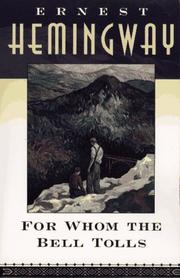
For Whom the Bell Tolls
2,286-word summary 10 min read 471 pages in the book
- First published
- 1940
- Publisher
- Charles Scribner's Sons
- Pages
- 471
- ISBN
- 9780684803357
Reading options
What's inside (7 sections)
I picked this one up because everyone talks about Hemingway's short sentences, and I wanted to see what he does when he gives himself room. Almost five hundred pages of room, set over just three days in the Spanish mountains. That compression is the first thing that hit me. The whole novel takes place between a Thursday and a Sunday in late May 1937, and by the end of it you feel like you have lived a season with these people.
The setup is simple enough to explain in a minute. Robert Jordan is an American, a former Spanish instructor from Montana, fighting for the Republic in the Spanish Civil War. He is good with explosives, and a Soviet general named Golz gives him an order: go behind the fascist lines in the Sierra de Guadarrama, join a band of guerrillas living in the pines, and blow up a steel bridge at exactly the right hour to support a coming offensive. That is the whole assignment. Everything else in the book grows out of it.
Even the title tells you what kind of book this is. It comes from John Donne, the English poet who wrote that no man is an island and that every death diminishes everyone. Hemingway prints part of Donne's meditation as the epigraph. The bell in a Spanish village rings for funerals, and the question is always who it rings for. The book's answer is that it rings for all of them, fascist and republican alike. That sounds grand stated flatly like that, but the novel earns it through particulars, through Anselmo worrying about his soul and a boy on a hilltop saying his prayers while the planes circle.
The old man in the pines
Jordan does not go in alone. An old guide named Anselmo meets him above the bridge and walks him up to the guerrilla camp hidden in the timber. Anselmo is maybe sixty eight, patient, devout in his own quiet way, and he becomes the moral center of the book for me. He has killed, and it troubles him. He prays, though he admits he is not sure the church he prays to deserves it. Jordan respects him almost at once, and the feeling runs both ways. There is a scene early on where they are just looking down at the bridge together, counting sentries and trucks, and you can feel the professional calm between them. Two men doing arithmetic about death.
The camp itself is a cave and a few lean shelters, and the band living there is a mixed lot. Agustin is foul mouthed and loyal. Fernando is middle aged, deliberate, irritating in the way of a man who wants everything done properly. Primitivo is older and steady. Rafael is called the gypsy and is mostly useless, though good natured about it. There are two brothers, Andres and Eladio. And then there are the two people who run the place, though only one of them admits the other does.
Pablo and Pilar
Pablo leads the band, or used to. When Jordan arrives, Pablo is drunk half the time and scared the rest of the way through. He smells danger in this bridge job and wants no part of it. He says the band has survived by being careful, and one dynamite charge will bring the fascist planes and patrols down on all of them. He is not wrong, exactly. That is what makes him interesting instead of just a villain. His fear is rational. But a guerrilla leader who will not fight is a problem, and everyone in the cave knows it.
His wife Pilar is the real power in the camp. She is big, blunt, kind in sudden flashes, and she reads people the way Jordan reads bridges. When Pablo refuses the job, she stands up in front of everybody and takes his leadership away from him, open and formal, in front of witnesses. It is one of the best scenes Hemingway ever wrote. She does not shout. She just states what is true, that Pablo has lost his nerve, and the band follows her instead.
Pilar also tells the longest story in the book, and it is brutal. She describes what happened in her village when the revolution came: how the local fascists were beaten in the town hall, lined up, and made to walk between two lines of villagers holding flails before being thrown off a cliff into the river gorge below. She tells it in full, man by man, including the ones who knelt and begged and the ones who walked out with a kind of dignity. She was there. She watched the whole thing. The point she keeps circling is that the cruelty felt good at the time and sickening afterward, and that both feelings were real. I had to put the book down for a bit after that chapter. It is not Hemingway showing off. It is the book admitting what war does to ordinary people, including the side you are supposed to root for.
Pablo, humiliated, seems to accept the new order. He even fetches horses for the getaway after the bridge job. Then, in the night, he steals Jordan's detonators and exploder and throws them into the gorge. Without them, the dynamite cannot be set off properly. It is sabotage disguised as caution, and Jordan wakes up to find his whole mission technically impossible.
There is a detail here that stayed with me. Jordan's predecessor on this job was a Russian named Kashkin, and Kashkin cracked under the strain before Jordan ever arrived. The knowledge sits in the back of Jordan's mind the whole time: the last man who held this assignment fell apart. It puts Pablo's theft in a colder light. Jordan is fighting the fascists and the clock, and underneath both, he is fighting the knowledge that this mission has already broken one good man, and that fear is contagious. When Pilar's band votes to back Jordan anyway, it feels less like bravery and more like stubbornness, which in this book counts for more.
Maria
The love story sits inside the war story, and I will be honest: it tested my patience in places. Maria is a young woman the band rescued after fascists killed her parents and assaulted her. Her hair was shaved by her captors and is growing back in a short crop, and Pilar has been sheltering her in the cave. Jordan falls for her within a day, and she for him. They talk about marriage after about forty eight hours. They have a famous night together in a sleeping bag in the heather where Jordan asks her if she felt the earth move, and yes, that line really is in the book, and yes, the whole world has been quoting it ever since.
Here is my fair criticism. The dialogue between Jordan and Maria is stylized to the point of creaking. Hemingway renders their Spanish into a literal, thee and thou English that is supposed to sound translated, and in the big romantic scenes it can read like two people talking through a prayer book. Edmund Wilson said something like this when the book came out, and he had a point. When Maria calls Jordan "my Roberto" for the tenth time, part of you wants to shake them both and tell them there is a bridge to blow up.
And yet. The scenes between them that work are the quiet ones, not the speeches. Maria telling Jordan what the train of her cropped hair means. Maria asking Pilar, woman to woman, whether she is really healed enough for this. Pilar answering honestly, that the body heals on its own schedule. Maria learning to shoot a pistol because nobody in that camp can afford to be helpless. Those passages land because Hemingway stops performing and just watches two damaged people being careful with each other. The romance earns its place because it gives Jordan something to lose, and the book needs that. Without Maria, Jordan is just a willing martyr. With her, the last hundred pages ache.
The hill and the message
The middle of the book keeps cutting between the cave and the wider war, and the war is going badly. A neighboring guerrilla band led by a man called El Sordo raids a fascist position to support Jordan's mission, gets tracked by cavalry through the snow, and ends up surrounded on a hilltop. What follows is one of the great set pieces in war fiction. El Sordo and five men, including a devout teenage communist named Joaquin, hold a hill against planes, mortars, and a captain who keeps demanding surrender through a megaphone. They refuse, politely. They keep shooting. The planes come back and finish them. Hemingway gives each of the dying men a paragraph of interior life as the bombs fall, and it is devastating precisely because he does not decorate it. The youngest, Joaquin, spends his last minutes reciting the Hail Mary over and over, and his faith is presented without a trace of mockery. Sordo, bleeding from several wounds, keeps joking with his men because that is what an officer does when there is nothing left to order. I have read a lot of last stands in fiction. This is the one I believe.
Meanwhile the fascists have learned about the Republican offensive. Jordan realizes the attack the bridge is meant to support will walk straight into prepared positions. He sends Andres, the most reliable young guerrilla, through the lines with a message for Golz: call off the bridge, or at least know the attack is betrayed. Andres's run through the night is its own small adventure, full of passwords, suspicious sentries, red tape at headquarters, and one communist border guard who nearly gets him shot as a spy. He reaches Golz, but too late. The offensive is already rolling. The order stands: blow the bridge.
I found this the most haunting part of the novel. The mission goes ahead not because it will work, but because the machinery cannot stop. Jordan knows the bridge will change nothing. He blows it anyway, because those are his orders and because his word is the only currency he has with the guerrillas. Hemingway, who covered this war as a reporter and watched the Republic lose it, writes this stretch without any illusions. Courage and futility can share the same hour. That is the whole Spanish war in one sentence, and the book knows it.
The bridge
The last fifty pages move fast after so much waiting, and they are worth the wait. Pablo, to everyone's surprise, comes back. Whatever broke in him seems to have mended, or maybe he just could not stand to be the man who ran. He brings extra men and the horses. Jordan, short of proper detonators, rigs the charge with hand grenades wired so their pins can be pulled from a distance. It means someone has to be close to the bridge when it goes. Anselmo volunteers to stay with him at the detonator point.
The attack itself is chaos done clearly: Pilar and the others hitting the sentry posts at both ends, Pablo covering the road, Jordan and Anselmo setting the charge under fire. The bridge goes up in a roar of steel and dust. And Anselmo, the gentle old man who worried over every life he ever took, is killed by a flying fragment as they run. Jordan weeps while running, which is about as much outward feeling as Hemingway ever allows one of his men, and that is why it lands so hard.
The getaway goes wrong in the way these things do. A tank shell kills Jordan's horse, and the animal falls on him and snaps his leg. He knows at once how bad it is. The bone is broken, the pain is beyond bearing, and he cannot ride. He does the arithmetic the same way he did it above the bridge on the first day: a man who cannot walk will get Maria and the others killed. So he stays. He sends Maria on with Pablo's group, and his goodbye to her is short because anything longer would break them both. Then he lies down behind a tree with a machine gun, bleeding, waiting for the fascist cavalry to come up the road so he can hold them long enough for the others to get clear.
The book ends there, with Jordan waiting, his finger on the trigger, thinking about his father and his grandfather and whether a man can borrow courage the way you borrow a tool. We never see the shot. Hemingway just leaves him lying against the pine trunk, alive and conscious and resolved, while the enemy rides closer. I sat still for a while after closing it.
A few things to carry away. First, the time scheme is a marvel: three days that contain a whole war, a whole love affair, and a whole argument about violence. Second, Pilar is one of the great characters in American fiction, and she alone is worth the price of admission. Third, the book trusts its reader with moral mess. The Republic's cause is just and its fighters do terrible things; the fascists are monsters and some of them die bravely on that hill. Fourth, the romance really is overwritten in spots, and the thee and thou business will make you grin at the wrong moments. It does not sink the book. Nothing could sink the bridge chapters and the hill chapters. But go in expecting to roll your eyes once or twice before the end breaks your heart, because it will.
FAQ
When was For Whom the Bell Tolls first published?
Charles Scribner's Sons published it on October 21, 1940, in a 471 page first edition, just after the Spanish Civil War ended.
Is the story based on real events?
Hemingway covered the Spanish Civil War as a reporter in 1937, and the Guadarrama setting, the Segovia offensive, and the Soviet officers draw on that war, though Jordan, Maria, and the band are fictional.
Where does the title come from?
It comes from John Donne's Meditation XVII of 1624, printed as the epigraph: never send to know for whom the bell tolls, because every death diminishes everyone.
Similar books
More like For Whom the Bell Tolls →
A Farewell to Arms
Frederic loves Catherine in Italy until desertion leads to Switzerland and stillbirth.
2,502-word summary · 11 min read
The Sun Also Rises
Jake Barnes drifts through Paris bars and Pamplona bullfights with Brett Ashley and a wounded generation.
3,187-word summary · 14 min read

War and Peace
Pierre, Natasha, and Andrei search for meaning amid the Napoleonic wars.
2,536-word summary · 11 min read

All Quiet on the Western Front
Paul Bäumer enlists at nineteen and faces the trenches of World War I in Remarque's 1929 classic, told from the German side of the wire.
2,543-word summary · 11 min read

Gone with the Wind
Scarlett O'Hara schemes through the Civil War and Reconstruction, from Tara to burning Atlanta, chasing Ashley while Rhett waits and watches.
2,049-word summary · 9 min read

Voyager
Claire returns through the stones in 1968 after learning Jamie survived Culloden.
2,901-word summary · 13 min read